|
Treatment
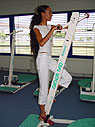
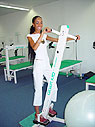
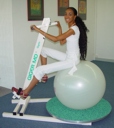
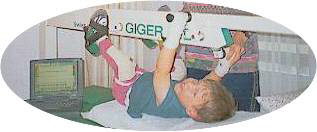
The GIGER MD®
Therapy gives new hope for patients with spinal cord lesions, brain injury, brain stroke or
other diseases affecting the Central Nervous System (CNS).

Coordination dynamic therapy is the new efficient method for
treating patients with lesions or diseases affecting the Central
Nervous System (CNS). This method is rehabilitating the CNS, unlike
many other methods which affect only the periphery. Moreover the
mobility of people with spina bifida can be improved at the same
time through the medical device
GIGER MD®
with greatest success.
Basis for the GIGER MD®
Therapy
The coordination
dynamic therapy is used to treat patients with CNS lesions.
Due to the 4 new
developments in human neurophysiology mentioned below, it is
possible to reorganize the lesioned or functionally impaired human
central nervous system (CNS). The 4 new repair-related concepts are:
-
The CNS is viewed
as a neuronal network which organizes itself. The organization
can be changed by re-learning.
-
The
self-organization is based on a relative (specifically changing)
phase- and frequency coordination of rhythmically firing sub
neuronal networks and single neurons.
-
Neurogenesis and
functional cell proliferation is induced and controlled by
learning. Methods for re-learning basic CNS functions use
especially rhythmic, dynamic, coordinated movements (GIGER MD®
medical device).
-
It seems from the
success in re-learning movements, vegetative and higher mental
functions in patients with CNS lesion that the human CNS has a
second integrative strategy to learn, re-learn, store and recall
network states.
Theory of coordination
dynamics of the lesioned human CNS and re-learning
The lesioned human CNS can be repaired by re-learning of partially
lost phase and frequency coordination through coordinated rhythmic
movements. The severely lesioned CNS can only efficiently be
repaired if integrative, coordinated functions are re-learned. The
re-learning of relative phase and frequency coordination of the
lesioned CNS can be achieved by:
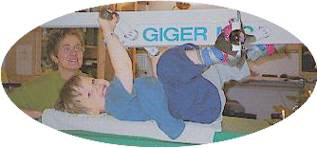
1. Using
the special coordination dynamic therapy device GIGER MD®
which offer exact phase and frequency coordination up to a few
milliseconds for re-learning.
2. The
training of automatisms, postures and old learned movements which
are only little impaired in their functioning by the lesion.
Rather than asking what is the best method to re-organize the
lesioned CNS we should ask what method is most efficient in
re-organizing the lesioned CNS by re-learning. The increase of the
rate of re-learning is determined by 4 factors:
-
The exactness of
the coordination of the performed movements during the therapy,
to functionally reconnect disconnected network parts to recouple
arms or legs that cannot be moved.
-
The increase of
the intergrativity of the coordination dynamic therapy, which
increases the number and complexity of simultaneously exercised
phase and frequency coordinations and makes it possible to
re-learn integrative functions such as the higher mental
functions.
-
The enhancement of
the movement induced re-afferent input to strengthen the
physiologic self-organization of the lesioned CNS and its
communication with the environment.
-
The increase of
the intensity of the therapy to force the “adaptive machine” CNS
to adapt.
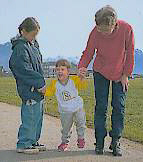
Because of measured phase and frequency coordination in the process
of neuronal network organization in man, the theory of coordination
dynamics is used for re-learning motor, vegetative, and higher
mental functions. The re-learning (repair) is seen as a change of
the existing inner coordination dynamics tendencies after the lesion
(with no or only pathologic functioning of arms, legs and trunk) to
achieve CNS coordination dynamics which will generate again
physiologic movements, vegetative and higher mental functions.
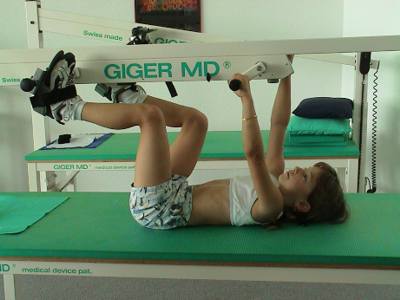
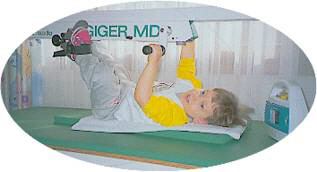
The change of the coordination dynamics is achieved by the
coordination dynamic therapy, especially by the
GIGER MD®
medical device.
The improvement of the
coordinated movement of an arm, finger or leg can be measured. The
improvement of the average coordination dynamics when exercising on
the special coordination dynamic therapy device can be used to
quantify the improvement of the inner coordination tendencies on the
macroscopic level.
back to the top
|